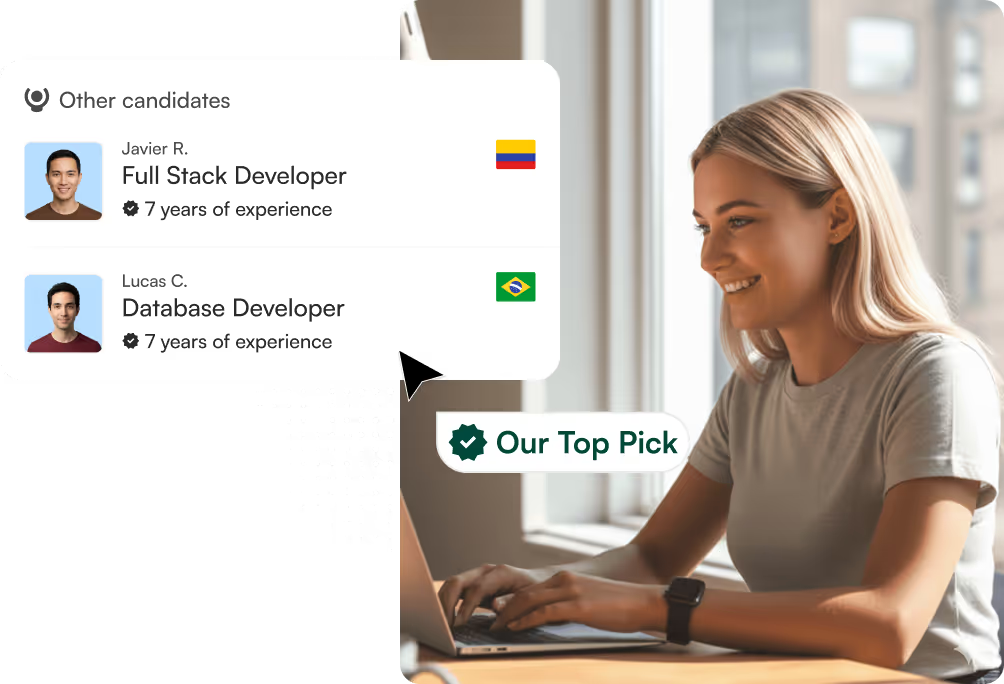
What is Recruitment Process Outsourcing: Full RPO Guide



Lupa will help you hire top talent in Latin America.
Book a Consultation Call
Lupa helps you build, manage, and pay your remote team. We deliver pre-vetted candidates within a week!
Book a Consultation CallCompanies today face a talent war where quality hires determine success or failure. Building world-class in-house recruitment teams requires significant investment in headcount, recruitment technology, training, and time that many growth-stage companies don't have. Recruitment process outsourcing (RPO) offers an alternative: experienced recruiting infrastructure on-demand.
RPO differs fundamentally from staffing agencies, which operate on a transactional, contingency-based model. RPO is strategic, embedded, scalable, and focused on building hiring systems rather than just filling positions. This is especially true for growth-stage companies building teams in Latin America, where embedded RPO models bring regional market insight and methodology that transactional staffing can't.
This blog covers what recruitment process outsourcing is, how it works, the benefits of recruitment process outsourcing, pricing models, fit assessment, and provider selection.
What is Recruitment Process Outsourcing (RPO)?
Recruitment process outsourcing is a strategic partnership model where an external service provider takes responsibility for some or all of an organization's recruitment function. RPO goes beyond a simple outsourced recruitment process; the provider becomes an extension of the internal HR team, often using the company's employer branding, working within their systems (ATS, HRIS), and integrating deeply with hiring managers.
The provider brings recruiting expertise, sourcing methodology, screening processes, recruitment technology, and dedicated RPO recruiters who function as embedded team members. This represents a fundamentally different approach than alternatives:
Staffing agencies operate transactionally, focused on filling specific roles quickly with success fees typically 15-25% of salary. Limited methodology transfer and minimal ongoing partnership.
Contract recruiters provide temporary help on hourly or project-based arrangements. They provide capacity but not necessarily methodology or systems that compound over time.
RPO solutions establish strategic partnerships with ongoing relationships that build recruiting infrastructure. Providers typically work on retainer or hybrid models, focusing on process improvement and scalable systems. Success gets measured through hiring outcomes like candidate quality, time to fill, and hiring manager satisfaction.
RPO sits between building your own recruiting team (expensive, time-intensive) and using staffing agencies as needed (transactional, inconsistent quality). RPO provides talent acquisition capabilities without the full internal build.
What is an RPO Provider?
RPO providers are specialized firms delivering end-to-end or partial recruitment services. They range from large global RPO companies serving enterprise clients to specialized providers focused on specific industries, company stages, or regions like embedded recruiting teams for LATAM-focused startups.
What RPO providers bring:
Recruiting expertise: Senior recruiters with deep experience in sourcing, screening, interviewing, and closing candidates. Strategic recruiting talent who understand what separates good hires from great ones.
Methodology and process: Proven frameworks for intake meetings, candidate profiling, recruitment strategies, screening criteria, interview structures, and offer management. Repeatable systems that produce consistent results.
Technology stack: Recruiting tools, ATS expertise, sourcing automation, CRM systems, and analytics dashboards. Infrastructure that would cost companies significant investment to build internally.
Scalability: Ability to flex recruiting capacity up or down based on hiring needs. Ramp quickly during growth phases, scale back during slower periods.
Market insight: Salary data, competitive landscape knowledge, sourcing channel effectiveness, talent availability insights. Service providers aggregate intelligence individual companies can't access.
RPO adoption is also shifting toward more flexible models. According to Everest Group's 2023 State of Global RPO report, most of the new RPO deals in 2022–2023 were project-based engagements rather than full-lifecycle contracts; a move toward the modular, flexible RPO models that growth-stage companies typically need.
The best RPO companies bring strategic perspective, challenge poor hiring decisions, improve hiring manager effectiveness, and build recruiting competency within client organizations over time.
How Does Recruitment Process Outsourcing Work?
Engagement Models
Full RPO (End-to-End): Provider handles the entire recruitment process from workforce planning through onboarding. Best for large organizations (500+ employees) with high-volume hiring needs.
Partial RPO (Selective Functions): Provider handles specific parts like sourcing only, screening and assessment, or recruiting for specific departments. Company retains other recruitment functions internally.
Project-Based RPO: Time-limited engagement for specific hiring initiatives like launching new offices or rapid team building. Fixed duration with specific hiring targets provides short-term recruiting solutions.
Embedded Recruiting: Hybrid model where RPO recruiters embed deeply with client teams, functioning as extensions of internal organization. Focuses on building sustainable hiring systems, not just filling current openings. Best for startups and growth-stage companies (50-500 employees) hiring 5+ roles annually. Learn more about the benefits of embedded recruiting teams for startups.
How RPO Partnerships Operate
The RPO recruitment process typically follows this flow: deep discovery about company culture and recruitment needs, process design and system integration to streamline workflows, dedicated recruiting team assignment, ongoing recruiting operations (sourcing, screening, coordination, offer management), continuous improvement based on data-driven insights and feedback, and detailed reporting on metrics like time to hire, cost per hire, and candidate quality.
The key differentiator: RPO providers embed deeply rather than operating at arm's length. Best providers function as true extensions of internal talent acquisition teams.
What Are the Benefits of Recruitment Process Outsourcing?
Companies outsourcing talent acquisition to an RPO partner see measurable gains across quality, speed, and cost. Research from the RPO Association and Lighthouse Research & Advisory found that companies using RPO reported 69% higher-quality hires and 61% lower cost-per-hire compared to in-house recruiting alone, and were twice as likely to report improved hiring consistency and predictability.
Access to Recruiting Expertise and Best Practices
RPO providers bring immediate recruiting expertise: senior recruiters who've made hundreds of placements, proven methodologies refined across multiple clients, and the ability to implement best practices from day one. Companies access talent acquisition capabilities that would take years to build internally.
Scalability and Flexibility
Hiring needs fluctuate dramatically in growth-stage companies. RPO provides flex capacity: scale recruiting resources based on actual recruitment needs, add specialized support for hard-to-fill roles, ramp quickly during growth phases. Companies pay for recruiting capacity they actually need rather than maintaining fixed costs.
Improved Hiring Quality and Consistency
RPO brings methodology-driven consistency: standardized screening criteria, structured interview processes, documented frameworks, data-driven improvements, and consistent candidate experience. The result: better candidate quality, reduced bad hires, improved retention, and more predictable hiring outcomes.
Reduced Time to Fill Critical Roles
RPO providers reduce time-to-fill through dedicated resources, established talent pools, efficient processes, and experience moving candidates quickly while maintaining quality. Average improvements of 30-40% are common for mission-critical roles that impact business goals.
Cost Efficiency and Predictable Investment
RPO provides cost predictability with known monthly or per-hire costs, eliminated technology expenses, reduced bad hire costs, and faster time to fill. Total recruitment costs typically run 20-30% lower than building equivalent in-house recruitment capacity, delivering significant cost savings.
Focus on Core Business
RPO allows leadership to refocus: trust in the hiring process, optimized hiring manager time, reduced operational distraction, and executive attention on business strategy. Companies buy back bandwidth for building products and growing revenue.
Market Intelligence and Competitive Insights
Service providers gain market insight through multiple client relationships: salary benchmarking, competitive landscape knowledge, sourcing channel effectiveness, and talent availability insights. This intelligence informs better hiring strategies and helps optimize recruiting approaches to attract top talent.
RPO Types and Engagement Models
Recruitment outsourcing isn't one-size-fits-all; providers structure engagements across several models depending on hiring volume and how much control a company wants to retain.
Full RPO: Complete outsourcing of the recruitment function for large enterprises with consistently high-volume needs.
Partial RPO: Selective outsourcing through functional, role-based, or geographic specialization. Best for companies augmenting existing talent acquisition teams.
Project RPO: Time-limited for specific initiatives. Best for occasional intensive hiring surges requiring short-term support.
Embedded Recruiting: Deep integration with client teams, bringing methodology while maintaining cultural alignment. Emphasizes RPO partnership over vendor relationship, quality over volume, and building compounding capabilities. Best for growth-stage companies (50-500 employees) hiring 5+ roles annually who view recruiting as a competitive advantage.
RPO Pricing Models
Monthly Retainer
Fixed monthly fee ($8,000-$15,000+ per full-time recruiter equivalent) for dedicated resources. Provides cost predictability and aligned incentives. Best for consistent recruitment needs (5+ hires quarterly).
Cost-Per-Hire
Fixed fees per placement ($5,000-$15,000 per hire). Pay-for-performance alignment but can incentivize speed over quality. Best for unpredictable hiring needs under 5 roles quarterly.
Hybrid (Retainer + Performance Fees)
Combination of base retainer plus success fees per hire. Balances predictability with performance alignment. Best for mid-sized engagements with moderate volume.
Percentage of Salary
Typically 15-20% of annual salary. Less common in strategic RPO partnerships. Similar to traditional contingency recruiting with recruitment agencies.
Typical Pricing Ranges
Small-scale (1-5 hires quarterly): $4,000-$8,000 monthly or $6,000-$10,000 per hire
Mid-scale (5-15 hires quarterly): $8,000-$20,000 monthly or hybrid model
Large-scale (15+ hires quarterly): $20,000-$50,000+ monthly for dedicated multi-person teams
Pricing varies based on role difficulty, market competitiveness, geographic scope, service level, and provider positioning. Many RPO models offer better cost per hire ratios than traditional in-house recruitment.
How Do Companies Know if RPO is a Good Fit?
RPO Makes Sense When:
Hiring 5+ roles per quarter, candidate quality and consistency matter more than minimizing cost, internal recruiting capacity is insufficient, specialized recruiting expertise is needed, leadership bandwidth is constrained, hiring is a strategic priority supporting business goals, and scalability is required. Consider how to make your talent acquisition strategy succeed.
RPO May Not Fit When:
Hiring volume is minimal (under 5 roles quarterly), in-house recruitment is working well, company culture requires very hands-on involvement, budget constraints are severe, or recruitment needs are extremely unpredictable.
Self-Assessment Questions:
How many hires do we plan annually? What does our current talent acquisition process actually cost? Are we losing qualified candidates to competitors? Do hiring managers trust current recruiting quality? Is recruiting consuming leadership bandwidth? Do we have recruiting expertise for our hardest-to-fill roles? Will we sustain current hiring levels for 12+ months?
Not sure how your answers stack up?
Book a free 20-minute consultation, and we'll walk through your hiring volume, budget, and timeline to tell you honestly whether RPO or a lighter-touch staffing model is the better fit for where you are right now.
Choosing an RPO Provider
Key Evaluation Criteria
Look for specialization and recruiting expertise in your industry, embedded versus outsourced approach, clear methodology and recruitment strategies, modern recruitment technology and automation, cultural fit and partnership approach, transparent metrics and reporting, strong references and case study examples, and pricing transparency with flexibility.
Red Flags to Watch For
Overpromising on timelines or costs, lack of methodology specificity, rigid one-size-fits-all RPO models, poor communication during the sales process, unwillingness to provide references or metrics, and focus on volume over candidate quality.
Critical Questions for Prospective Providers
Who specifically would work on our account? Walk me through your complete hiring process. What's your average time to hire for similar roles? How do you ensure candidate quality and optimize candidate experience? What recruitment technology do you use? How do you measure success? Can you share a case study from similar companies? What happens if hires don't work out? How do you handle feedback and continuous improvement?
Recruitment Process Outsourcing FAQs
What is the difference between RPO and traditional staffing agencies?
RPO is a strategic partnership focused on building infrastructure and methodology. Staffing agencies are transactional, contingency-based relationships. RPO providers embed with client teams using retainer or hybrid models with lower cost per hire. Staffing agencies charge success fees (15-25% of salary) only when placements are made.
What is the difference between RPO and BPO?
BPO is a broader category of outsourcing entire business functions, including human resources. RPO is a specific type of BPO focused only on the recruitment function.
What do RPO companies do?
RPO companies handle workforce planning, sourcing from talent pools, screening and assessment, interview coordination, offer management, onboarding support, recruiting analytics, and continuous process improvement. Best RPO services build recruiting capabilities within client organizations through thought leadership and knowledge transfer.
How much does RPO cost?
Typical ranges: $4,000-$8,000 monthly for small-scale, $8,000-$20,000 monthly for mid-scale, $20,000-$50,000+ monthly for large-scale. Per-hire RPO solutions range from $5,000-$15,000 per placement. Total cost is usually 20-30% lower than equivalent in-house recruitment capacity.
How is RPO different from MSP?
MSP focuses on managing contingent workforce and contractors. RPO focuses on recruiting full-time permanent employees as part of core talent strategies.
What industries benefit most from RPO?
Technology, healthcare, financial services, manufacturing, and professional services particularly benefit. Growth-stage companies across industries benefit when hiring volume justifies dedicated recruiting solutions.
How long do typical RPO engagements last?
Strategic RPO partnerships typically run 12+ months and often extend multiple years. Project-based engagements may last 3-6 months for short-term needs. Look for reasonable commitment terms (6-12 month initial) rather than rigid multi-year contracts.
What is RPO recruiting?
RPO in recruiting is when an external provider manages part or all of a company’s hiring process. The provider supports sourcing, screening, employer branding, reporting, and recruitment strategy while remaining accountable for defined hiring outcomes.
What is RPO staffing?
RPO staffing refers to recruitment process outsourcing used to fill roles at scale or on an ongoing basis, rather than one-off placements. It differs from a traditional staffing agency in that the RPO provider embeds with the client's team, owns the process design, and is measured on hiring outcomes across an ongoing engagement, not paid per individual placement like a staffing firm.
Building Hiring Systems That Compound
Most companies fill roles reactively. Few build hiring systems that consistently identify the right talent who thrive long-term. For U.S. companies building teams in Latin America, this challenge intensifies. LATAM isn't one market. Mexico, Colombia, Argentina, and Brazil require different recruitment strategies.
Lupa has helped 450+ clients hire 1,200+ candidates across Latin America, cutting recruitment costs by roughly 60% on average. Book a discovery call to see how embedded RPO could work for your team.
For companies hiring 5+ roles annually where early hires disproportionately impact trajectory, quality arbitrage beats maximum savings. Learn more about how to build a strong culture with a remote team and talent retention strategies.
Book a discovery call to discuss how Lupa's RPO services can help you hire remote workers who elevate your team.

"What I love about Lupa Hire is their approach to sharing small, carefully selected batches of candidates. They focus on sending only the three most qualified individuals, which has already helped us successfully fill 20+ roles.”


"Talking about Lupa Hire, I would say: these are the people you want to work with. They understand what consultancies are like. They understand that they could work for a month on a req, only to have it pulled because a client contract didn’t go through. You understand our business model, and that is invaluable."

"We came to Lupa Hire with a need to hire key tech and AI positions in Latin America. Our target when working with them was to find the best of the best in the region and they delivered. Their approach goes beyond what you'd expect from a headhunter with an incredible focus on match quality."