Hire Product Managers Who Turn Customer Insight Into Shipped Outcomes



Lupa will help you hire top talent in Latin America.
Book a Consultation Call
Lupa helps you build, manage, and pay your remote team. We deliver pre-vetted candidates within a week!
Book a Consultation CallThe trigger for this hire is rarely a headcount line item. It shows up as a symptom: a founder still writing every spec at 2am, an engineering team that ships fast but ships the wrong thing, a roadmap that resets every time a big customer or a loud executive asks for something new. When decisions about what to build next are made by whoever is in the room instead of by evidence, this is the hire that fixes it.
The right product manager profile depends on the company’s stage and operating environment.
- Early-stage startup: The first product manager usually needs to run customer discovery, define priorities, write specifications, and work closely with founders and engineers. The role requires comfort with ambiguity and the confidence to reject weak ideas.
- Scaling company: The product manager may coordinate across several engineering, design, and go-to-market teams. They must turn broader company strategy into priorities other teams can plan against.
- Agency or product-services business: The product manager should own discovery, prioritization, and product outcomes while translating client goals into technically realistic decisions. If the position primarily manages schedules, budgets, resources, and delivery coordination, the company may need a project manager instead.
- Enterprise: The product manager must work through established processes, legacy systems, security requirements, compliance constraints, and multiple decision-makers without losing sight of the customer and business outcome.
Product Manager vs. Product Owner vs. Project Manager
These roles may work closely together, but they do not own the same decisions.
Some companies combine parts of these roles. The job description should clearly state which decisions the person will own instead of relying on the title alone.
Which Type of Product Manager Do You Need?
First or Generalist Product Manager
Best for an early-stage company that needs one person to conduct discovery, define priorities, write requirements, and work directly with founders and engineers.
Technical Product Manager
Best for infrastructure, APIs, developer tools, integrations, cybersecurity, data platforms, or products where technical dependencies strongly influence product decisions.
Growth Product Manager
Best when the priority is acquisition, activation, conversion, engagement, retention, or monetization. This profile should be comfortable with experimentation and funnel analysis.
Platform Product Manager
Best for shared services, internal platforms, data foundations, or capabilities used by several products and engineering teams.
Domain-Specialist Product Manager
Best when industry knowledge materially affects product decisions, such as fintech, healthcare, insurance, logistics, cybersecurity, or regulated software.
AI Product Manager
Best when the role must define AI-powered experiences, understand model limitations, manage trust and data considerations, and connect AI capabilities to a genuine customer problem.
Where Lupa Sources Product Management Talent
Product-management talent is distributed across Latin America. The right sourcing market depends on the role’s seniority, product type, industry experience, English requirements, compensation, and required overlap with U.S. business hours.
Lupa evaluates each country as a distinct hiring market rather than treating Latin America as one interchangeable talent pool. For one search, relevant experience may be concentrated among startup product managers in a major technology hub. Another search may require candidates with enterprise, fintech, healthcare, platform, or data-product experience.
The search should begin with the required candidate profile, not with a predetermined country. Lupa can then focus on the markets most likely to produce qualified candidates for that specific product environment.
How Lupa Evaluates Product Managers
A strong title or polished resume does not prove that a candidate has owned meaningful product decisions. Lupa evaluates product managers across six areas:
- Product ownership: What product, feature area, or measurable outcome did the candidate personally own?
- Customer discovery: How did they collect, interpret, and validate customer evidence?
- Prioritization judgment: What did they build, delay, reduce, or reject, and why?
- Cross-functional leadership: How did they align engineering, design, sales, support, and leadership without depending on formal authority?
- Data and outcome measurement: Which metrics defined success, and what changed after launch?
- Communication: Can they explain difficult decisions clearly to technical, commercial, and executive audiences?
Candidates should be able to describe specific decisions, evidence, tradeoffs, and outcomes instead of only naming product frameworks.
How Lupa Builds Your Product Manager Shortlist
Lupa runs each product manager search through four focused stages:
- Define the role: We clarify the company stage, product environment, level of ownership, domain requirements, compensation, working-hour overlap, and outcomes the hire will be expected to influence.
- Run a targeted search: A senior recruiter maps the relevant markets across Latin America and reaches qualified candidates directly, including experienced professionals who may not be actively applying.
- Evaluate product judgment: Candidates are assessed against the agreed criteria, including discovery, prioritization, product ownership, data fluency, communication, and cross-functional leadership.
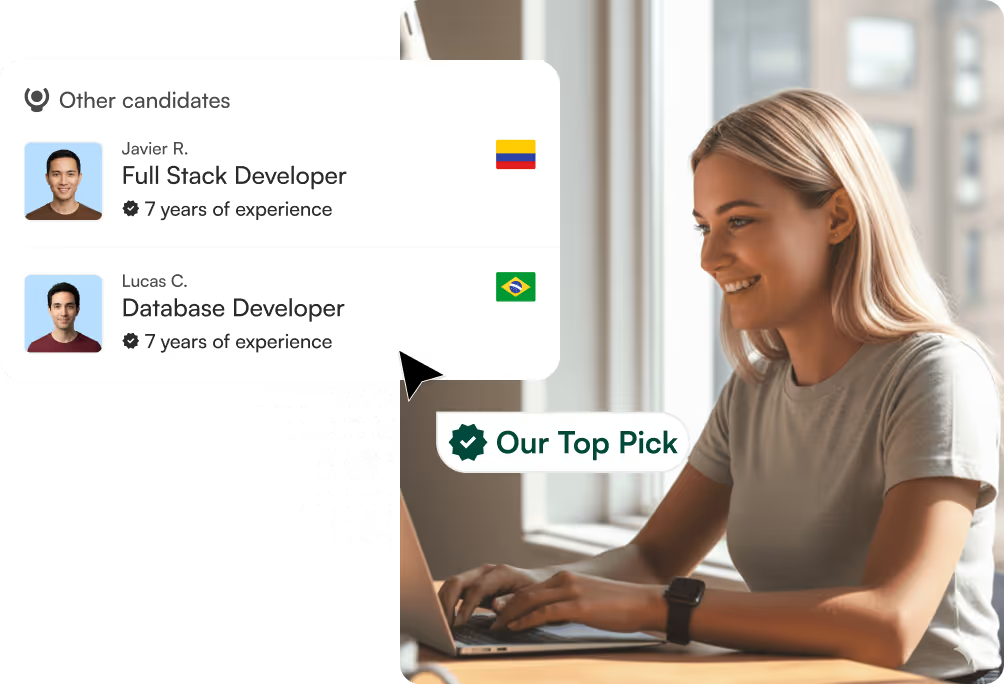
- Deliver a curated shortlist: You receive 3 to 4 candidates with context on their experience, achievements, expectations, and fit against the role. Lupa explains the evidence behind each recommendation, while your team remains in control of the final hiring decision.
Most searches are designed to produce a qualified shortlist within a week after the role and selection criteria have been agreed.
What a Strong Product Manager Looks Like
- A strong hire does not begin by rewriting the roadmap. During the first month, they talk to customers, review support tickets and product data, and work with sales, engineering, and design to understand what is influencing current decisions. Their first proposed change should be focused, evidence-based, and connected to a clear customer or business problem.
- They treat saying no as part of the job, not a failure of diplomacy. A strong product manager can tell a founder or an executive that their favorite idea is not the next priority, and back it up with evidence the room accepts.
- They know the difference between a feature request and the problem underneath it. When a customer asks for something specific, they dig for the job the customer is actually trying to get done, and sometimes ship something different from what was asked for.
- They write specs engineers can actually build from, with edge cases and success criteria spelled out, not vague intent left for someone else to interpret at implementation time.
- They use AI with judgment. They use it to synthesize customer feedback, draft specs faster, or model scenarios, but they can explain exactly where a human decision replaced or overrode the AI output and why.
Product Manager Soft Skills
Influence Without Authority
Aligns engineering, design, sales, support, and leadership even when those teams do not report directly to the product manager.
Tradeoff Communication
Explains why one problem deserves attention before another and makes the consequences of each choice understandable to stakeholders.
Decision-Making Under Uncertainty
Makes a defensible call when customer evidence, commercial pressure, available data, and technical constraints do not point to one obvious answer.
Customer Empathy Without Feature-Taking
Understands the problem beneath a customer request instead of treating every requested feature as a product requirement.
Written Decision Clarity
Documents context, assumptions, requirements, edge cases, decisions, and success measures clearly enough for other teams to act.
Commercial Judgment
Connects product priorities to customer value, adoption, retention, revenue, operating cost, or strategic positioning.
Product Manager Skills
Product Strategy and Business Judgment
Connects product decisions to company strategy, customer value, competitive positioning, and commercial goals instead of treating the roadmap as a collection of feature requests.
Product Discovery and Customer Research
Runs structured customer conversations and interprets feedback, support tickets, and usage data to find the real problem behind a request.
Roadmap Prioritization
Builds and defends a prioritized roadmap using evidence and clear tradeoffs, not just whoever asked most recently.
Spec Writing and Requirements
Writes specs with edge cases and success criteria clear enough for engineers to build from without guessing.
Data and Analytics Fluency
Reads product usage data and experiment results well enough to make and defend a call, without needing an analyst to interpret every number.
Experimentation and Outcome Measurement
Defines what success should look like before launch, selects appropriate metrics, and uses experiments or post-launch evidence to determine whether the product decision worked.
Cross-Functional Coordination
Aligns engineering, design, and go-to-market teams around a shared plan, and keeps that plan honest as reality changes.
AI-Assisted Product Workflows
Uses AI tools to synthesize customer feedback, draft specs, or model scenarios faster, while owning the judgment calls those tools cannot make.
Technical and Product-Tool Fluency
Works confidently with product-planning, analytics, experimentation, documentation, and collaboration tools. Familiarity with platforms such as Jira, Linear, Amplitude, Mixpanel, or similar tools can help, but the candidate should also understand the work those tools support.
A product manager does not need to be an engineer, but they should be technically fluent enough to discuss feasibility, dependencies, data, edge cases, and scope tradeoffs with an engineering team.
Common Mistakes When Hiring Product Managers
- Screening on frameworks and certifications instead of shipped outcomes: Anyone can recite a prioritization framework in an interview. Ask every candidate to walk through one product decision they made, what evidence drove it, and what happened after they shipped it. If they start with the framework name, keep looking. If they start with the customer problem and the tradeoff they made, you are onto something.
Treating the regional cost advantage as a license to underpay. You already save significantly by hiring in Latin America. Use that advantage to bring on a stronger product manager rather than pushing the rate to the floor. Underpaid product managers are easy to poach, and a roadmap with no continuity is expensive in ways that never show up on the invoice.
- Using the Regional Cost Difference to Push Compensation Too Low: The cost difference between markets should help you hire a stronger candidate, not reduce compensation to the lowest possible number. Product managers accumulate customer context, product decision history, and cross-functional trust that can be expensive to replace.
Set compensation according to the candidate’s market, seniority, domain experience, and level of ownership. An offer that is not competitive for the profile creates avoidable retention risk and can interrupt product continuity.
- Writing a job post that oversells the level of ownership: If the role reports into a VP who makes most of the real calls, say so. If a senior hire will actually own a roadmap end to end, say that too. Retention starts at the job description, and a mismatch between promised and actual authority is one of the fastest ways to lose a strong hire in the first quarter.
- Hiring a generalist for a role that actually needs domain depth, or the reverse: A product manager who thrives on ambiguity at an early-stage startup can struggle inside an enterprise's approval chains, and a product manager built for enterprise process can stall without any structure to work inside. Test for fit with your actual stage, not just for general product management ability.
- Skipping a Structured Work Sample Because the Candidate Has an Impressive Title: Product-manager titles differ considerably between companies. Ask the candidate to work through a realistic product problem or discuss a redacted artifact they are authorized to share.
Evaluate how they frame the problem, identify missing information, compare tradeoffs, communicate a decision, and define success. Do not require confidential documents from a previous employer, and do not score presentation polish more heavily than product reasoning.
How to Write an Effective Job Post for Hiring Product Managers
Recommended Titles
Common titles include Product Manager, Senior Product Manager, Technical Product Manager, Growth Product Manager, Platform Product Manager, and Group Product Manager.
Use Product Owner when the role primarily owns backlog detail, user stories, acceptance criteria, and day-to-day delivery decisions for a development team. Do not use Product Owner as a direct substitute when the position must own customer discovery, product strategy, market decisions, and business outcomes.
Role Overview
You are hiring someone to turn customer problems and business goals into a roadmap your engineering team can actually build against, and to own the tradeoffs that come with saying yes to some things and no to others.
The job post should also state which decisions the product manager can make independently and which decisions require leadership approval.
Role Requirements
- Proven track record owning a product roadmap and shipping decisions that moved a real business metric.
- Experience running customer discovery and translating findings into prioritized work.
- Comfort writing specs detailed enough for engineers to build from without hand-holding.
- Working fluency with product analytics tools and enough data literacy to defend a decision with evidence.
- A track record of saying no to stakeholders and making that no stick.
Experience in the company’s actual product environment or industry when specialist knowledge materially affects product decisions.
Role Benefits
Describe the benefits and level of authority that genuinely apply to the position:
- Clearly defined product ownership and decision rights
- Direct access to customers, product data, and cross-functional stakeholders
- Real-time collaboration with engineering, design, and go-to-market teams
- Visibility into the company’s product and business strategy
- A defined path from owning a feature or roadmap to leading a broader product area
Do not promise end-to-end ownership if senior leadership retains the final product decision. Candidates should understand what they can decide independently and what requires approval.
What to Test For
- Judgment about tradeoffs: give them a real prioritization conflict from your business and ask how they would decide, and what they would tell the stakeholder who loses.
- Evidence habits: ask how they would validate a feature request before committing engineering time to it. Strong candidates talk about customer conversations and data, not intuition alone.
- Communication under disagreement: have them walk through a time they told a senior stakeholder no. The role lives at the boundary between what customers want and what the business can build.
- Outcome Orientation: Ask the candidate to explain how they defined success before a launch and what they did when the outcome did not match the original expectation.
What a Product Manager Work Sample Should Prove
Use a redacted artifact the candidate is authorized to share or run a short live exercise based on a realistic product problem. Do not require confidential specifications, roadmaps, customer data, or internal company documents.
The assessment should show whether the candidate can:
- Frame the customer and business problem clearly
- Identify missing information and important assumptions
- Compare competing priorities and explain the tradeoffs
- Translate the decision into requirements or a practical next step
- Define how success would be measured
- Communicate the decision to technical and non-technical stakeholders
- Explain whether AI was used and how its output was verified
Score the reasoning and evidence behind the decision, not document polish alone.
Red Flags
- Every example is a framework recited in the abstract, with no real product, customer, or outcome attached to it.
- They cannot describe a decision they got wrong. Product managers who have shipped real work have a story about a bad call.
- They talk only about what they built, never about what they chose not to build.
- They present AI-generated analysis as evidence but cannot explain how they verified the sources, challenged the conclusions, or corrected weak output.
Do
- Describe the actual level of ownership and who makes the final call when opinions differ.
- Use a redacted work sample or realistic live exercise to evaluate product judgment.
- Explain the company stage, product environment, business model, and type of ambiguity the candidate will face.
Don’t
- Do not screen on years of experience alone. Evaluate the scope and outcomes the candidate has owned.
- Do not treat certifications or framework knowledge as proof of product judgment.
- Do not position Latin America only as a way to reduce cost. Position the region as access to qualified talent at better business value.
Top Related Roles In Demand
- Hire project managers
- Hire AI product managers
- Hire data science product managers
- Hire artificial intelligence product managers
- Hire business intelligence analysts
- Hire data analysts
Top Interview Questions for Product Managers
Product Judgment and Execution
- Walk us through a product decision you made. What evidence drove it, and what happened after you shipped it?
- How do you decide what to prioritize when engineering, sales, and customers all want different things next?
- Tell us about a spec you wrote. How did you handle the edge cases engineering found that you had not considered?
- How do you validate a feature request before committing real engineering time to it?
- Where have you used AI in your product workflow, and where did you keep the decision human?
- How do you measure whether something you shipped actually worked?
- What would you do during your first 30 days before proposing a major change to the product priorities?
- Tell us about a decision where customer evidence, revenue pressure, and engineering constraints pointed in different directions. How did you make the call?
Leadership and Cross-Functional Collaboration
- Tell us about a time you told a senior stakeholder no. How did you explain the decision and maintain alignment?
- Describe a product decision you got wrong. What did you learn, and what did you change?
- How do you handle a roadmap that keeps getting reshuffled by whoever asked most recently?
- Tell us about a time you had to build trust with an engineering team that did not know you yet.
- Describe working through ambiguity when there was no clear answer on what to build next.
Why Lupa for Product Manager Hiring
Product-manager titles do not always reveal how much ownership a candidate has actually held. One candidate may have owned strategy, discovery, prioritization, and business outcomes. Another may have mainly coordinated delivery against decisions made by someone else.
Lupa defines the role before sourcing begins, including the company stage, product environment, decision authority, customer exposure, domain requirements, and outcomes the hire will be expected to influence.
A senior recruiter then evaluates candidates against the agreed criteria: customer discovery, prioritization, specification writing, analytics, cross-functional influence, communication, and decisions they personally owned.
You receive a curated shortlist of 3 to 4 candidates with context on their experience, achievements, expectations, and fit. Lupa runs the sourcing and evaluation process, while your team retains control of the interviews and final hiring decision.
Choose the Right Product Manager Hiring Model
Recruiting
Lupa finds and evaluates candidates, and your company hires the selected product manager directly. This model suits companies making a permanent hire and managing the employment relationship themselves.
Staffing
Lupa finds the product manager and manages the contractual and payroll arrangement. This model is useful when the company wants ongoing employment and administrative support.
Recruitment Process Outsourcing
A dedicated Lupa recruiter works as an extension of your talent team for ongoing or higher-volume hiring. This model is suitable for companies building several roles or expanding an entire product organization.
The right model depends on the number of hires, the preferred employment arrangement, and the amount of ongoing recruiting support the company requires.
Frequently Asked Questions About Hiring a Product Manager
How quickly can Lupa present product manager candidates?
Lupa typically delivers a curated shortlist within a week after the role, selection criteria, compensation, and candidate profile have been agreed. Highly specialized searches may require additional market mapping.
How does Lupa vet product managers?
Candidates are evaluated for product ownership, customer discovery, prioritization, data fluency, specification writing, cross-functional leadership, communication, and measurable outcomes. The evaluation focuses on decisions the candidate personally made rather than framework knowledge alone.
Can product managers in Latin America work with U.S. teams?
Yes. Lupa can prioritize candidates who have substantial overlap with the client’s working hours and experience collaborating with distributed U.S. teams. Meeting schedules and customer-facing responsibilities should be defined before sourcing begins.
What type of product manager should we hire?
The right profile depends on the product, company stage, technical environment, growth priorities, and level of ownership. An early-stage company may need a broad generalist, while an infrastructure product may require a technical product manager and an acquisition-focused product may require a growth product manager.
What is the difference between a product manager and a product owner?
A product manager generally owns customer problems, product priorities, strategy, and outcomes. A Product Owner commonly focuses on backlog clarity, user stories, acceptance criteria, and day-to-day delivery decisions for a development team.


"What I love about Lupa Hire is their approach to sharing small, carefully selected batches of candidates. They focus on sending only the three most qualified individuals, which has already helped us successfully fill 20+ roles.”


"Talking about Lupa Hire, I would say: these are the people you want to work with. They understand what consultancies are like. They understand that they could work for a month on a req, only to have it pulled because a client contract didn’t go through. You understand our business model, and that is invaluable."

"We came to Lupa Hire with a need to hire key tech and AI positions in Latin America. Our target when working with them was to find the best of the best in the region and they delivered. Their approach goes beyond what you'd expect from a headhunter with an incredible focus on match quality."