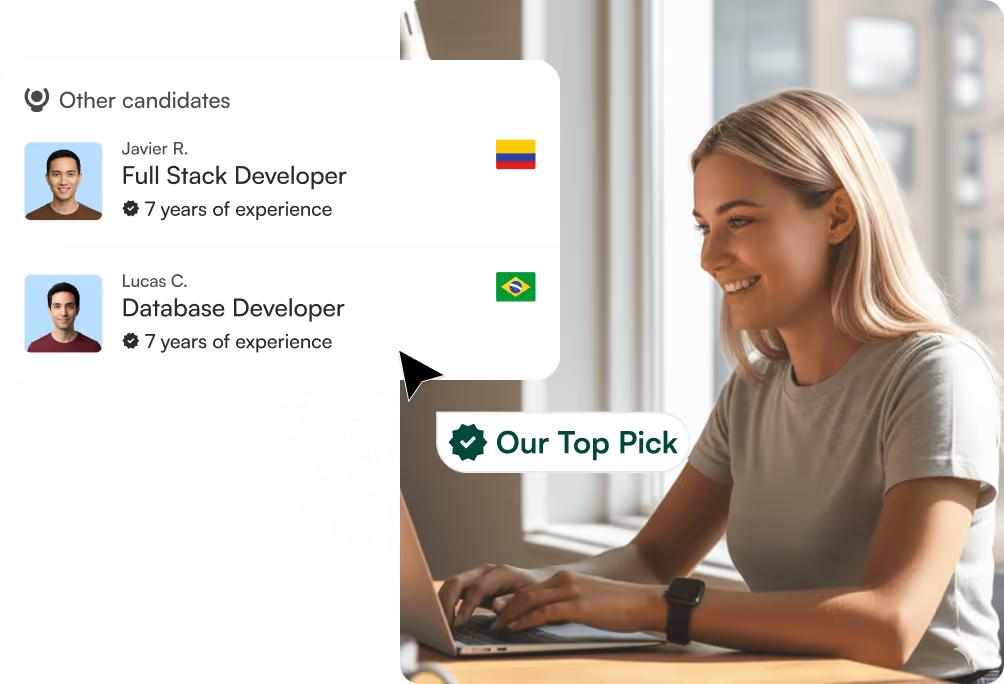
Hire Nearshore Developers in Latin America



Lupa will help you hire top talent in Latin America.
Book a Consultation Call
Lupa helps you build, manage, and pay your remote team. We deliver pre-vetted candidates within a week!
Book a Consultation CallYour roadmap is bigger than your team. Tickets sit in the backlog because there is no one to pick them up, code review turns into a queue, and every new feature competes with the ones already half built. Hire a nearshore developer, and that pressure eases immediately: someone joins your stand-ups in real time, picks up tickets the same day they are written, and ships pull requests your team reviews before lunch instead of overnight.
Latin America puts that person on your clock. This working-hour alignment is one of the main advantages of nearshore software development for US companies. Developers here work inside your working hours, not eight or twelve time zones away, so pairing, debugging, and sprint planning happen live instead of over async messages that lose a day each time. And because you already start from a favorable cost position by hiring in the region, you can select for a developer who has shipped production code under real constraints instead of settling for whoever clears a take-home test. That is exactly what Lupa vets for.
When Hiring Nearshore Developers Matters
The trigger for this hire is rarely abstract. It shows up as a specific bottleneck: a backlog that keeps growing because there is no bandwidth to touch it, a single engineer who is now the only person who understands half the codebase, or a roadmap commitment made to a client or a board that the current team cannot hit without help. When shipping speed is capped by headcount rather than by ideas, this is the hire that raises the ceiling.
The role also changes with company stage. In an early-stage startup, the first nearshore developer is often the second or third engineer overall, working directly with the founder or CTO, so range matters more than specialization and comfort with an unfinished codebase is the real requirement. In a scaling company, the need is usually a specific gap: Some companies may need to hire backend developers to strengthen server-side development.
A backend developer to unblock an API rewrite, a specialist to own a service the core team does not have time for. In an agency or services business, nearshore developers extend delivery capacity across client projects. So consistency and the ability to context-switch between codebases matter as much as raw skill. In an enterprise, the developer joins an established team with existing standards, security review, and architecture decisions already made, and the bar shifts toward fitting into process without slowing it down.
Where This Talent Is Strong in Latin America
Costa Rica is home to arguably the strongest developer talent in the region, with the highest English fluency and the closest cultural proximity to the United States, at a higher price point given the small market. Argentina pairs a strong tech ecosystem with the highest level of agency in the region, which is useful when a developer needs to operate with real independence. Brazil has its own deep, separate tech ecosystem, including several billion-dollar Brazil-only companies, but it runs on Portuguese and is best staffed with Brazil-based recruiting rather than treated as interchangeable with the rest of the region.
Lupa's Proven Process
Your path to hiring success in five days:
Day 1 · Define the role. Together we define the role, the ideal candidate profile, compensation, and cultural fit, and we turn that into explicit selection criteria you sign off on before the search starts.
Day 2 · Targeted search. A senior recruiter who knows this function maps the market across Latin America, working outbound to reach the strong passive candidates who never apply. AI assists the research; a human runs every conversation.
Day 3 and 4 · Evaluation. We assess more than 30 candidates with proven track records against the selection criteria from Day 1, so every evaluation traces back to what you said matters.
Day 5 · Shortlist delivery. You receive a curated shortlist of 3 to 4 top candidates with full profiles: proven background, key achievements, and expectations. We walk you through how each one measures against your criteria, and you make the hiring decision with full context.
What a Strong Nearshore Developer Looks Like
- In the first weeks, a strong hire does not wait to be handed perfectly scoped tickets. They read the codebase, ask specific questions about the parts that seem fragile, and start shipping small, correct changes before they touch anything architectural.
- Every member of a nearshore development team should show up live in your working hours. Stand-ups, pairing sessions, and urgent bug fixes happen in real time, not as messages left overnight and answered the next afternoon.
- Their pull requests are reviewable. Small, well-scoped changes with a clear description of what changed and why, not a single sprawling diff that takes a reviewer an hour to untangle.
- They flag risks before they become incidents. If a change affects something load-bearing, they say so and ask for a second set of eyes rather than quietly merging and hoping.
- They write code someone else can maintain. Naming, structure, and tests reflect that the codebase will outlive their tenure on the project.
Nearshore Developer Soft Skills
Communication
Explains work clearly to technical and non-technical audiences and keeps stakeholders aligned.
Problem Solving
Breaks ambiguous problems into workable steps and reasons toward reliable solutions.
Team Collaboration
Works well across functions, shares context, and moves the whole team forward.
Adaptability
Adjusts quickly as priorities, tools, and requirements change.
Time Management
Prioritizes across competing demands and delivers dependably.
Attention to Detail
Catches the small errors that create big downstream problems.
Nearshore Developer Skills
Core Language Proficiency
Teams with Python-based products may need to hire Python developers. Writes clean, idiomatic code in the languages your stack runs on, whether that is JavaScript, Python, Java, or another primary language, with the judgment to know house conventions matter.
API and Backend Integration
Companies building or connecting complex systems may need to hire API developers.
Builds and consumes REST or GraphQL APIs, handles authentication, and integrates cleanly with the services your product already depends on.
Testing and Code Quality
Writes unit and integration tests as part of the work, not as an afterthought, and leaves pull requests that are easy for a teammate to review.
Version Control and Collaborative Workflows
Works fluently in Git, follows your branching and review conventions, and communicates changes clearly enough that a reviewer does not have to guess.
Cloud and Deployment Familiarity
Comfortable working with common cloud platforms and CI/CD pipelines, and can debug an issue that only shows up in a deployed environment.
System Design Judgment
Data-heavy products may need to hire database developers who can reason about how a change affects the rest of the system and raise a flag before a fix in one place breaks something else.
Debugging Production Issues
Diagnoses real incidents methodically under time pressure, using logs and monitoring rather than guesswork.
Common Mistakes When Hiring Nearshore Developers
- Hiring fast on the assumption that Latin American rates are automatically low. Pushing for the lowest possible rate on top of an already favorable cost position is the most common mistake companies make. It leads to bad hires, high turnover because underpaid developers are easy to poach, and training costs when the quality is not there. Save 50 to 60 percent and get a much stronger developer, instead of chasing 70 to 80 percent and getting a weaker one.
- Screening resumes for keywords instead of demonstrated work. A list of languages and frameworks on a resume tells you almost nothing. Ask for a real code sample or a walkthrough of a production system the candidate built, and listen for how they talk about what broke and what they would change.
- Writing a job post that oversells the codebase or the tooling. Retention starts at the job description. If the stack is older than the post makes it sound, or the role is 60 percent maintenance rather than new feature work, say so. A developer who arrives with no surprises stays.
- Treating every Latin American country as interchangeable. Argentina, Mexico, Colombia, Costa Rica, and Brazil have different talent density, English fluency, agency levels, and cost structures for developers. A search built for one market rarely transfers cleanly to another, and Brazil in particular needs its own approach.
- Skipping a real working session before the offer. A resume and a single interview will not show you how someone actually codes under real conditions. A short paid work sample or a live pairing session on a real ticket reveals far more than another round of questions.
How to Write an Effective Job Post for Hiring Nearshore Developers
Recommended Titles
Nearshore Developer, Nearshore Software Engineer, Remote Developer, Latin America, Software Engineer, Nearshore.
Role Overview
You are hiring a developer based in Latin America who works inside your team's existing working hours, joins your sprint from day one, and ships production code your team reviews and merges the same way it reviews anyone else's.
Role Requirements
- Proven experience shipping production code in your primary stack, not just coursework or personal projects.
- Comfort working inside an established codebase alongside an existing team, rather than building something from scratch.
- Working English sufficient for daily stand-ups, pull request discussions, and live pairing.
- A track record of writing code and tests that a teammate can pick up and maintain later.
- Experience with the version control and CI or CD conventions your team already uses.
Role Benefits
- Real-time overlap with your team's working hours, not async handoffs across a wide time-zone gap.
- Direct ownership of tickets and features, not a queue of isolated tasks.
- Exposure to your existing codebase, architecture decisions, and review culture from week one.
- Room to grow from feature work into ownership of a service or a domain of the product.
What to Test For
- Real-code fluency: walk through a pull request they are proud of and ask what they would change if they wrote it again today.
- Working-hours reliability: confirm they can genuinely overlap your team's core hours, not just answer messages the next morning.
- Collaboration under review: have them talk through how they respond to tough code review feedback, since joining an existing team means their code gets judged against a standard they did not set.
What a Work Sample Should Prove
- A pull request or code sample from a real production system, not a solo side project built for the interview.
- Evidence they wrote or updated tests alongside a real feature, showing the work was built to last past the first release.
- A debugging story: a production issue they diagnosed and fixed, including what the logs or monitoring told them.
Red Flags
- Every example is a personal project with no evidence it ever ran in front of real users.
- They cannot describe a code review that went badly or a time their work was pushed back on.
- Vague or evasive answers about which hours they can actually work, which usually means the overlap will not hold up.
Do
- Describe your actual stack, codebase age, and the specific gap this hire fills.
- Ask for a real code sample or a short paid work session on an actual ticket.
- State the working hours you need covered, clearly and specifically.
Don't
- Do not screen on a list of frameworks alone. Ask to see the work.
- Do not undersell or oversell the codebase. Be honest about what the day-to-day work looks like.
- Do not frame the region as a way to pay less. Frame it as access to strong developers at better value.
Top Interview Questions for Nearshore Developers
Technical
- Walk us through a pull request from a production system you are proud of. What would you change about it today?
- Tell us about a bug that only showed up in production. How did you track it down?
- How do you approach making a change in a codebase you did not write, without breaking something you cannot see?
- What does your testing approach look like when you are shipping a feature under time pressure?
- Describe how you have used our stack, or the closest equivalent, to solve a real integration problem.
- How do you keep a pull request small and reviewable when the underlying change is genuinely complex?
Behavioral
- Tell us about a time code review feedback pushed back hard on something you built. How did you respond?
- Describe working across time zones or tight overlap windows on a previous team. What made it work or not work?
- Tell us about joining an existing codebase or team. What did you do in the first few weeks?
- Describe a moment you flagged a risk before shipping, even though it slowed things down.
- Tell us about a deadline you almost missed. What did you do?
Why We Stand Out From Other Recruiting Firms
Senior Specialized Recruiters
Your search is run by a senior recruiter who knows the function, the market, and the candidate profile, never a junior generalist. We do not flood you with resumes. We run a precise search and deliver a shortlist of 3 to 4 candidates who clear the bar you set.
Local Expertise
We are on the ground across Latin America and know each market as its own country, not one interchangeable region. That is how we reach the strong passive candidates other firms miss.
Direct Control
You stay in control of the process end to end. We run the search, evaluation, and shortlist, and you make every hiring decision with full context.
Clean Cross-Border Hiring
We handle the contractual and legal complexity of hiring across borders so onboarding is clean, compliant, and fast, wherever your new hire is based.
Why Lupa for This Search
Nearshore developer searches live or die on two things that are easy to get wrong from a distance: whether the person can actually do the work, and whether their hours truly overlap yours. Companies comparing direct hiring with nearshore software development services should first decide whether they need embedded talent or outsourced project delivery. Lupa runs this search with a senior recruiter who evaluates real code and production experience rather than a keyword match, and who confirms working-hours overlap before a candidate ever reaches your calendar.
We also help you define the profile before the search starts: which parts of your stack the developer needs to be fluent in on day one, how much independence versus structure the role calls for, and what a fair offer looks like for the seniority you actually need. You get a shortlist of 3 to 4 developers who clear that bar. Companies filling several technical roles may choose to hire a dedicated development team, with full context on each, and you make the final call.
Frequently Asked Questions About Hiring Nearshore Developers
1. What is nearshore software development?
Nearshore software development means working with developers located in nearby countries with overlapping business hours. For US companies, hiring in Latin America enables real-time stand-ups, sprint planning, code reviews, and problem-solving.
2. Why should US companies hire nearshore developers in Latin America?
US companies hire nearshore developers in Latin America to access strong technical talent that can work within their existing schedules. The time zone overlap reduces communication delays and helps developers integrate into ongoing sprints and workflows.
3. How do you build a nearshore development team?
Start by defining the required tech stack, seniority, responsibilities, and working-hour overlap. Candidates should then be evaluated for production experience, communication, code quality, and their ability to work within an established nearshore development team.
4. How much does it cost to hire nearshore developers?
The cost depends on the developer’s country, seniority, technical specialization, and hiring model. Companies should compare code quality, retention, communication, and long-term value rather than choosing the candidate with the lowest rate.
5. Should we hire developers directly or use nearshore software development services?
Nearshore software development services may suit companies that want a vendor to manage a specific project or deliverable. Direct hiring is better when you want developers to join your internal team, retain product knowledge, and contribute to your long-term roadmap. Lupa helps companies recruit pre-vetted developers for this embedded model.


"What I love about Lupa Hire is their approach to sharing small, carefully selected batches of candidates. They focus on sending only the three most qualified individuals, which has already helped us successfully fill 20+ roles.”


"Talking about Lupa Hire, I would say: these are the people you want to work with. They understand what consultancies are like. They understand that they could work for a month on a req, only to have it pulled because a client contract didn’t go through. You understand our business model, and that is invaluable."

"We came to Lupa Hire with a need to hire key tech and AI positions in Latin America. Our target when working with them was to find the best of the best in the region and they delivered. Their approach goes beyond what you'd expect from a headhunter with an incredible focus on match quality."