Hire Forward Deployed Engineers in Latin America | Lupa



Lupa will help you hire top talent in Latin America.
Book a Consultation Call
Lupa helps you build, manage, and pay your remote team. We deliver pre-vetted candidates within a week!
Book a Consultation CallLupa helps companies hire forward-deployed engineers from Latin America who combine full-stack development, production AI experience, and customer-facing judgment. Receive a curated shortlist in under 7 days and build your team in as little as 21 days.
Lupa's Proven Process
Your path to hiring success in 4 simple steps.

Day 1: Define the role. Together, we'll create a precise hiring plan, defining your ideal candidate profile, team needs, compensation, and cultural fit.
Day 2: Targeted search. Our tech-enabled search scans thousands of candidates across Latin America. We leverage advanced tools and regional expertise to build a comprehensive talent pool.
Day 3 and 4: Evaluation. We carefully assess 30+ candidates with proven track records. Our rigorous evaluation ensures each professional brings relevant experience from industry-leading companies, aligned to your needs.
Day 5: Shortlist delivery: Receive a curated selection of 3-4 top candidates with comprehensive profiles. Each includes proven background, key achievements, and expectations, enabling you to make informed hiring decisions.
What Is a Forward Deployed Engineer?
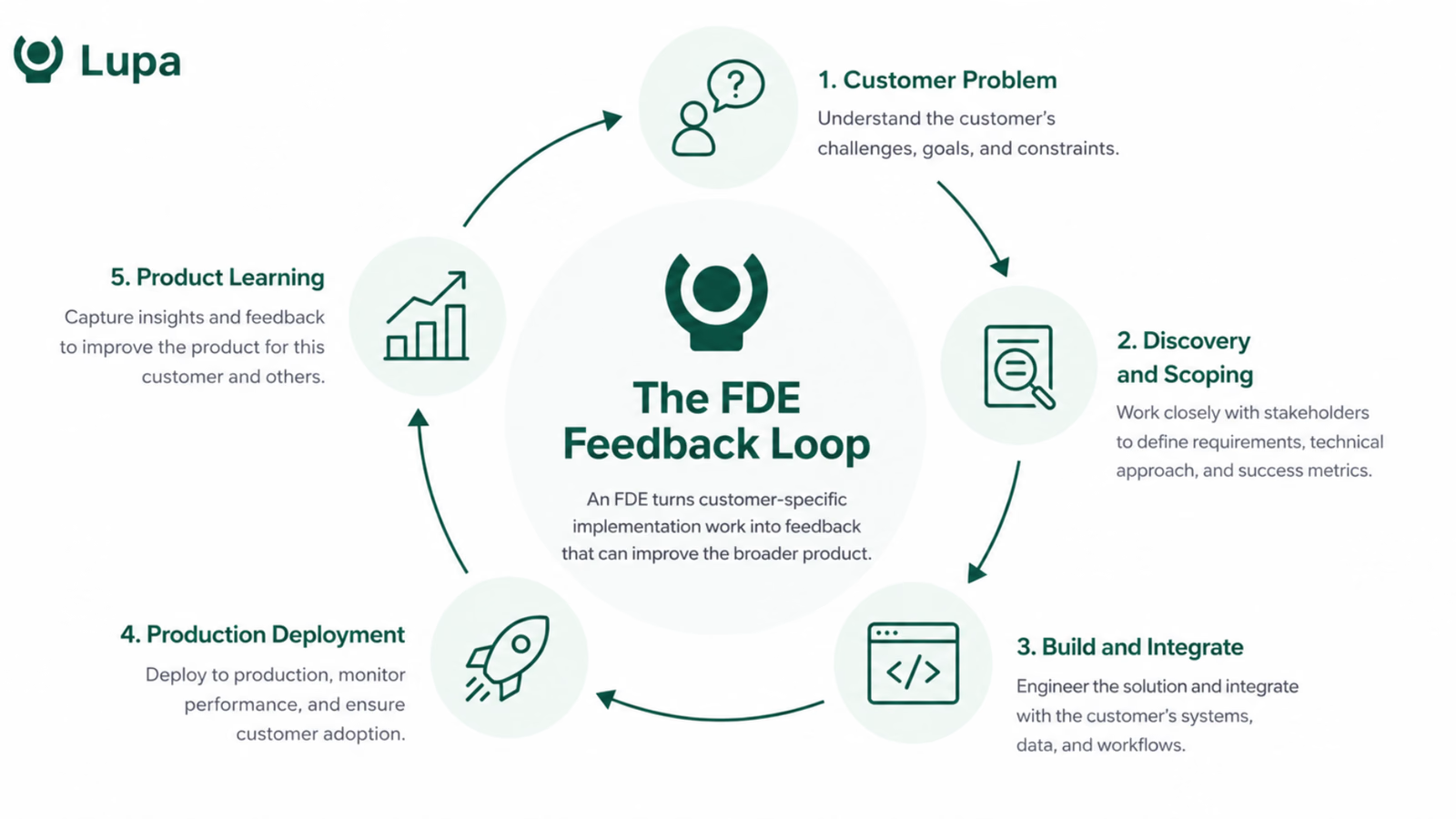
A Forward Deployed Engineer (FDE) is an engineer who embeds with a customer to close the gap between what your product does today and what that customer actually needs. Instead of building features in isolation, they sit inside the customer's problem: their workflows, their data, their stack, and their stakeholders.
Palantir popularized the forward-deployed model by embedding engineers directly with enterprise customers to accelerate implementation and product adoption. The model has since expanded across AI and data companies.
OpenAI, for example, describes its FDE team as working between customer delivery and core platform development. Its engineers own discovery, technical scoping, system design, implementation, production rollout, and the feedback that helps shape future product development.
Three forces explain why demand is climbing right now.
- AI deals are large and high-stakes, which means companies can justify sending engineers to make sure the product works in production, not just in a demo.
- Sensitive data and regulated industries (finance, healthcare, government) require trust, permissions, and longer-term access that only a deployed engineer can responsibly hold.
- Decision-makers are skeptical of AI until they see it working on their own data, and a Forward Deployed Engineer is the person who makes that happen.
A Forward Deployed Engineer is part engineer, part consultant, part product thinker. That combination is the whole point.
Forward Deployed Engineer vs Software Engineer
Both roles write production code, but they are measured against different outcomes. An FDE focuses on customer-specific implementation and time-to-value, while a traditional software engineer builds reusable capabilities for the broader product.
The roles reinforce each other. FDEs identify customer needs and validate solutions, while the core engineering team turns repeatable lessons into scalable product capabilities.
Forward Deployed Engineer Soft Skills
The soft skills that make a Forward Deployed Engineer effective.
Customer empathy
Reads the room, listens for the real problem behind the stated request, and earns trust with stakeholders who may be skeptical of AI.
Clear communication
Explains technical trade-offs to non-technical decision-makers and represents your company well in every customer conversation.
Scoping judgment
Knows what to build, what to skip, and when a fast prototype beats a perfect system. Comfortable with ambiguity.
Low ego, high ownership
Collaborates without territory, takes responsibility from discovery through production, and follows through after the contract is signed.
Adaptability
Moves between codebases, domains, and customer environments without losing momentum.
Forward Deployed Engineer Hard Skills
The technical capabilities on which this role depends.
Full-stack engineering
Ships end-to-end features across backend services, APIs, and customer-facing interfaces. Depending on the scope, companies may also need dedicated Full Stack Developers, Python Developers, or Node.js Developers.
AI in production
Integrates LLMs into live systems, with practical knowledge of prompt engineering, structured outputs, tool calling, evaluations, and guardrails. Teams building a broader AI function can also explore Lupa’s AI Developers and Machine Learning Engineers.
Agentic and retrieval systems
Builds at least one of: retrieval-augmented generation, agentic workflows, MCP servers and clients, vector search, or LLM observability.
Depending on the customer environment, the stack may include OpenAI or Anthropic APIs, AWS Bedrock, Azure OpenAI, Google Vertex AI, LangChain or LlamaIndex, Pinecone or Weaviate, Supabase, Snowflake, MCP-compatible tools, and OpenTelemetry-based monitoring.
The role brief should include only the technologies that are relevant to the actual deployment.
Data and integrations
Models data for transactional systems in PostgreSQL and integrates third-party services such as credit bureaus, KYC providers, banking rails, and document services.
Cloud and operations
Deploys to AWS, GCP, or similar, with working CI/CD, observability, and sound operational practices.
Pragmatic AI judgment
Knows when to use AI versus deterministic logic, weighing cost, latency, reliability, and risk, especially in regulated environments.
AI Capabilities to Evaluate in an FDE
An FDE does not need to know every AI framework. What matters is whether they can move an AI use case from an early concept into a reliable customer environment.
Production AI Delivery
Look for experience deploying AI features used by real customers—not only demos or internal prototypes. Candidates should understand monitoring, failure handling, security, latency, and ongoing improvement.
AI Evaluations
Strong candidates should know how to test whether an AI system produces accurate, consistent, and useful results. Ask how they selected evaluation criteria and responded when performance fell below expectations.
Guardrails and Risk Controls
An FDE should be able to reduce unsafe, incorrect, or out-of-scope outputs through validation rules, permissions, fallback logic, human review, and other practical controls.
Retrieval-Augmented Generation
RAG is relevant when a customer needs AI responses based on internal documents or business data. Candidates should understand data retrieval, source quality, permissions, and how to reduce unsupported answers.
Agentic Workflows
For systems that complete multi-step tasks, look for experience connecting models with tools, APIs, and business processes. The candidate should also know how to limit actions, manage failures, and maintain human oversight.
LLM Observability
Candidates should be able to monitor output quality, errors, latency, token usage, and cost after deployment. This helps teams identify issues and improve the system using real production signals.
MCP and Tool Integration
Knowledge of Model Context Protocol can be useful when the product connects AI applications with multiple tools and data sources. Treat it as a role-specific advantage rather than a universal requirement.
Build an Accurate FDE Role Brief
A focused role brief helps attract stronger candidates and prevents the search from drifting into generic software engineering.
FDE Role Brief Checklist
- Define the customer problems the engineer will solve.
- Clarify the deployment outcomes they will own.
- List the product stack and core technologies involved.
- Identify the customer systems, APIs, and data environments they will work with.
- Specify the required level of production AI experience.
- Explain how much direct customer interaction the role includes.
- State whether travel or live customer collaboration is expected.
- Define the seniority needed to handle ambiguity and make independent decisions.
- Include the compensation range and benefits.
- Clarify the employment or engagement model.
- Review Lupa’s guide to direct hiring, staffing, contractor, and EOR models before finalizing the employment structure.
- Outline the success metrics for the role.
- Separate essential requirements from preferred qualifications.
Avoid adding long lists of unrelated frameworks. Overly broad requirements can discourage qualified candidates without improving the quality of the search.
When Should You Hire a Forward Deployed Engineer?
A Forward Deployed Engineer is the right hire when your product needs real implementation work to deliver value, and you can invest in doing it well. The model pays off in a few clear situations.
- Your product needs deep integration with a customer's stack before it delivers value, and your margins support hands-on delivery.
- You sell into regulated industries where approvals, compliance, and trust make it hard to ship and iterate from a distance.
- You are entering a new vertical or customer segment and need to learn the space by embedding with early customers.
- Strategic accounts require custom implementation work that cannot be handled by customer success or pre-sales teams alone.
The role may be unnecessary when customers can onboard successfully through a standardized, self-service implementation process.
Top Related Roles in Demand
- AI Developer
- Full Stack Developer
- Software Developer
- Machine Learning Engineer
- Node.js Developer
- React JS Developer
- Python Developer
- Data Scientist
Top Interview Questions for Forward Deployed Engineers
Essential questions for evaluating Forward Deployed Engineers, grouped by what you are testing.
Technical and AI delivery
Tell me about an AI feature you shipped to production. What broke, and how did you make it reliable? Look for real production experience: evals, guardrails, fallback logic, and an honest account of failure modes, not a prototype story.
When have you chosen not to use AI for a problem? Strong candidates show judgment about cost, latency, and reliability, and can explain when deterministic logic is the better call.
Walk me through how you would integrate our product with a customer's existing systems. Listen for a structured approach to APIs, data, authentication, and the unknowns they would surface early.
Customer-facing and scoping
Describe a time you turned a vague customer request into a working solution. Look for discovery instincts: how they found the real problem, scoped it, and decided what to build first.
How do you handle a stakeholder who doesn't believe the product will work? Great answers involve showing results on the customer's own data rather than arguing.
Behavioral
Tell me about a deployment that went sideways. What did you do? Seek ownership, composure, and the ability to keep both the code and the relationship intact under pressure.
How do you decide when a scrappy prototype is good enough to ship? Look for pragmatism and a clear sense of when speed beats polish.
Red flags
- Talks about AI only in terms of demos or side projects, never production.
- Avoids customer contact or treats stakeholder work as a distraction.
- Cannot explain a technical decision in plain language.
- Over-engineers when a fast solution was the right answer.
- Goes quiet when a deployment gets hard.
Why We Stand Out From Other Recruiting Firms
Lupa has supported 450+ global clients and 1,200+ hires. Our process combines regional market knowledge, curated shortlists, and long-term match quality rather than resume volume.
Local expertise
We know the Latin American engineering market deeply: who has real deployment and AI-in-production experience, where they are, and how to reach them. That knowledge is the difference between a fast hire and the right hire.
Direct partnership
You keep full control of your hiring process. We bring the research, the shortlist, and the regional insight, and we work alongside your team from the first conversation through onboarding.
Seamless compliance
We handle contracts, tax, and labor regulations across Latin America, so you can hire a Forward Deployed Engineer without the legal guesswork or hidden costs.
Across Lupa’s company-wide placements, 97% remain after one year, and 95% of clients return for another hire.
Final Thoughts
Start by defining the customer problems, technical scope, AI requirements, and level of ownership the role demands. Then choose the right hiring model, align on compensation, and evaluate candidates against a consistent scorecard.
A clear brief and focused screening process will help you avoid generic software profiles and identify an FDE who can deliver real customer outcomes from day one.
Ready to Hire Forward Deployed Engineers in Latin America?
Lupa will help you hire exceptional Forward Deployed Engineers from Latin America, with care.
Frequently Asked Questions
Can a software engineer transition into an FDE role?
Yes. Software engineers can move into the role by developing customer discovery, technical scoping, stakeholder communication, and end-to-end implementation ownership alongside their coding skills.
Which industries hire FDEs?
FDEs are commonly hired in AI, enterprise software, fintech, healthcare, cybersecurity, data infrastructure, and government technology, especially where products require complex integrations or high-touch implementation.
Which programming languages and tools do FDEs use?
Requirements depend on the product, but common skills include Python, TypeScript, JavaScript, Go, SQL, APIs, cloud platforms, containers, vector databases, and monitoring tools.
How is an FDE different from a solutions engineer?
A solutions engineer typically supports technical sales, demonstrations, and pre-sale solution design. An FDE usually takes greater ownership of post-sale coding, integration, deployment, and production outcomes.
How long does Lupa’s hiring process take?
Lupa typically presents a curated shortlist of three to four candidates within one week. Most clients complete the wider hiring process within approximately 21 days, depending on interview schedules and technical assessments.


"What I love about Lupa Hire is their approach to sharing small, carefully selected batches of candidates. They focus on sending only the three most qualified individuals, which has already helped us successfully fill 20+ roles.”


"Talking about Lupa Hire, I would say: these are the people you want to work with. They understand what consultancies are like. They understand that they could work for a month on a req, only to have it pulled because a client contract didn’t go through. You understand our business model, and that is invaluable."


"We came to Lupa Hire with a need to hire key tech and AI positions in Latin America. Our target when working with them was to find the best of the best in the region and they delivered. Their approach goes beyond what you'd expect from a headhunter with an incredible focus on match quality."